Christmas is by far the most widely celebrated Christian holiday in
the Western world. However, it is also the most widely secularized
Christian holiday. Many of the Catholic traditions that were done in the
past in the countries of our ancestors have all but gone here in
America. The Christmas tree tends to be the only remnant of what was a
distinct Christian culture that dwelt in the homes during this time of
year. This is unfortunate, for the principal way that our children know
and practice the faith is how it is taught in the home. If our children
come home to an entirely secular way of celebrating Christmas, it should
come as no surprise to see so many children that do not know what
Christmas is about. In the end, if they know more about Santa Claus then
Jesus Christ, it is hard for our children to celebrate Christmas for
what it truly is.
The family was always meant to be a
“domestic church,” where the father and mother passed down to their
children what it meant to be a Christian. God revealed this to us all
the way back in the time of Noah and Abraham. This still holds true
today and has been reiterated by Blessed John Paul II and Pope Benedict
XVI. Consequently, when celebrating Christmas, our children are supposed
to learn from us what this feast means and how it impacts their lives.
Yet,
we are not always good with talking to our children. In this modern age
it is even more difficult with cell phones, iPods, etc. However,
sometimes it isn’t always our words that affect our kids the most as our
actions. In particular, it is very often the traditions of Christmas
that speak to our children and ingrain in them a knowledge that words
can not do.
What
then can we do as parents to impart to our children the true meaning
of Christmas? The best place to start is to rediscover the Catholic
traditions that our great grandparents used to pass on the faith. For
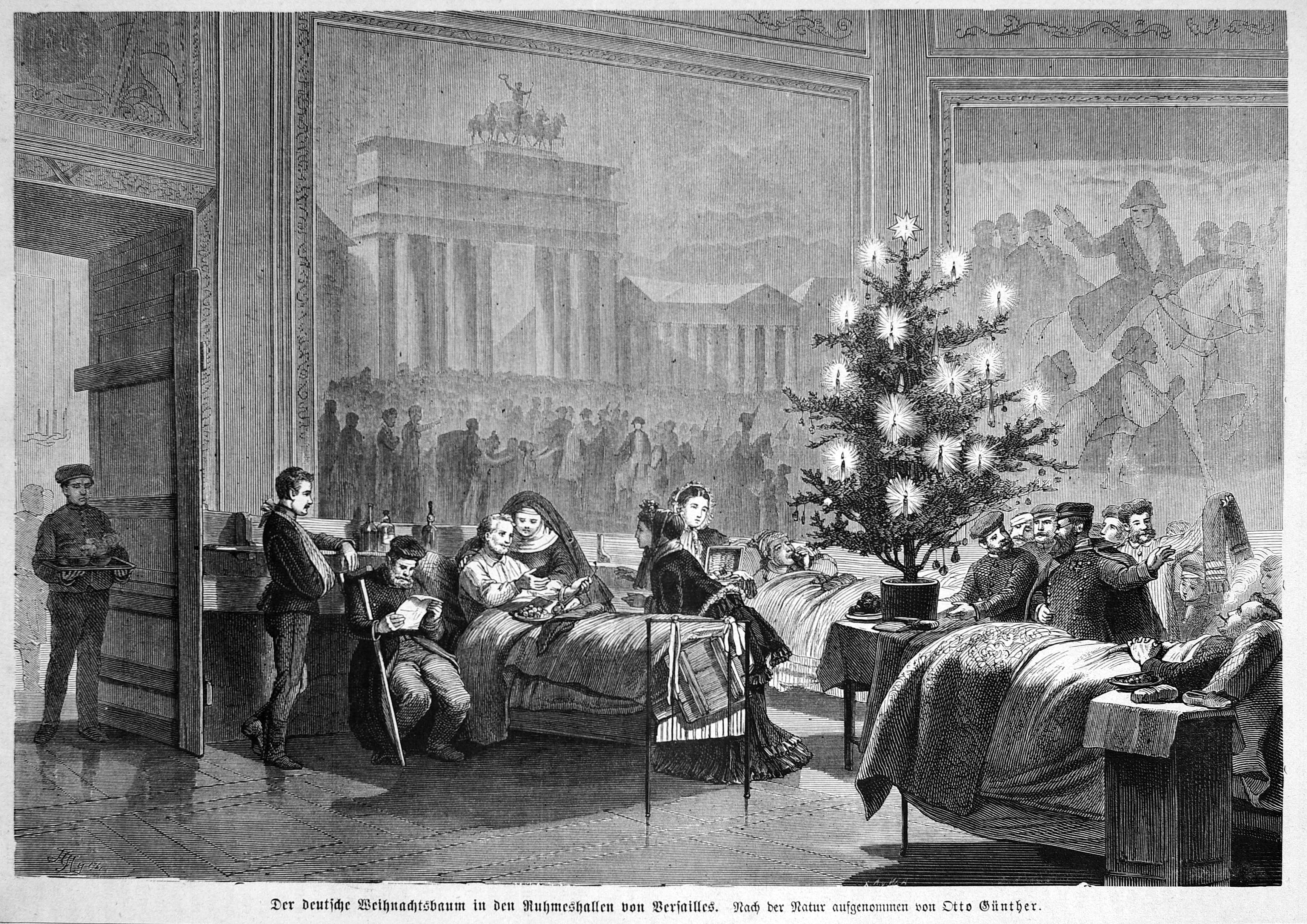
example, the tradition of the Christmas tree was always reserved for the
season of Christmas. When does the season of Christmas start? Christmas
Eve. Your great-grandparents never put up their Christmas tree until
Christmas Eve, for that is why it is called a Christmas tree to begin
with. Here is part of the reason why it has been tradition to wait until
December 24th:
The most important clue to the origin of the Christmas tree as we
know it comes from the mystery and miracle plays, and in particular
from the Tree of Good and Evil in the earthly Paradise.
These
plays were first performed in the late Middle Ages and their purpose
was to teach religion. It should be remembered that people in general
were illiterate. To spread and to keep the faith alive, to make known
the Sacred Scriptures, preaching was essential.
It was thought
that acting out Bible and Gospel episodes for the humbler classes
would facilitate this task. As a rule, these religious plays were
enacted for the celebration of an episode or of the saint whom they
featured, and they became popular throughout Europe. A famous play was
the performance put on for holy Christmas, celebrated on 25 December.
On Christmas Eve, 24 December, Adam and Eve would be
commemorated with the highly popular episode of the Tree of the earthly
Paradise; they would tower on the stage together with the devil,
disguised as a serpent, Eve picking an apple and Adam eating it.
Original sin, expiated by Jesus born on the 25th, was symbolized on
the night of 24 December. The tree ought to have been an apple tree,
but since an apple tree would have been inappropriate in winter, a fir
tree was set on the stage and some apples put on its branches or, to
symbolize the future coming of Redemption, wafers prepared with
crushed biscuits in special moulds that were symbols of the
Eucharistic presence of Jesus, as well as sweets and gifts for
children.
Even when the religious tableaux were abandoned, the
Tree of Paradise continued to be associated with Christmas in many
people's minds.[Catholic Culture]
Consequently,
when putting up Christmas trees in the home became a tradition in
Germany, they always refrained from putting it up until Christmas Eve.
Also, since the tree wasn't put up until the 24th, the tree was not
taken down until January 6th. This date is the day when the Magi came to
visit the baby Jesus and is called the Epiphany. This more traditional
usage of the Christmas tree spans the liturgical season of Christmas
instead of Advent.
This is not to say you cannot have a tree up before Christmas Eve, but
there is also a tradition called the “Jesse Tree” which is an Advent
tradition to help us prepare for Christmas. This tree is put up at the
very beginning of Advent and so would correspond with the American
tradition of putting up the tree after Thanksgiving. Here is a little
about the Jesse Tree:
The Jesse Tree dates back to the middle ages and came
from Europe. Even some ancient cathedrals have Jesse Tree designs in their
stained glass windows. The "tree" is usually a branch or sapling
and is decorated with various symbols that remind us of the purpose and
promises of God from Creation to the Birth of Jesus Christ.
Jesse was the father of King David and God promised David
that his Kingdom would last forever. Two centuries after the death of
King David, God spoke through the prophet Isaiah and said:
And there shall come forth a rod out of the stem of
Jesse, and a branch shall grow out of his roots: and the spirit of the
Lord shall rest upon him: the spirit of wisdom and understanding, the
spirit of counsel and fortitude, the spirit of knowledge, and of the
fear of the Lord. (Isaiah 11:1-2)
Each Jesse Tree ornament usually
consists of a handmade symbol or drawing that represents one of the major
stories of the Old Testament along with a brief verse of Scripture from
that story. [
Catholic Culture]
Another
tradition deals with a fast that was kept on Christmas Eve, and after
going to Midnight Mass, there would be a grand feast to celebrate
Christ’s birth. This tradition reflects the penitential attitude of
Advent. It also displays perfectly the adage, "Fast before you Feast."
A Polish tradition is the special observance of Christmas Eve and a special meal on that day:
For days in advance, Poles prepare the traditional foods
and everyone anxiously awaits the moment when the first star, known as
the Gwiazdka, appears in the eastern sky. For that is when the feast to
commemorate the birth of the Christ Child begins.
There is always a thin layer of hay under the white tablecloth in
memory of the Godchild in the manger. Before sitting down at the table,
everyone breaks the traditional wafer, or Oplatek and exchanges good
wishes for health, wealth and happiness in the New Year. This is such a
deeply moving moment that often tears of love and joy are evoked from
the family members who are breaking this symbolic bread. The Oplatek is a
thin, unleavened wafer similar to the altar bread in the Roman Catholic
Church. It is stamped with the figures of the Godchild, the blessed
Mary, and the holy angels. The wafer is known as the bread of love and
is often sent by mail to the absent members of the family.
A lighted candle in the windows symbolizes the hope that the Godchild,
in the form of a stranger, may come to share the Wigilia and an extra
place is set at the table for the unexpected guest. This belief stems
from the ancient Polish adage, "A guest in the home is God in the home."
The Wigilia is a meatless meal, no doubt the result of a long-time
Church mandate that a strict fast and abstinence be observed on this day
before Christmas. Although the Church laws have been revised and permit
meat to be eaten on this day, the traditional meal remains meatless.
Items that would normally be included in a traditional Wigilia menu
include mushroom soup, boiled potatoes (kartofle), pickled herring
(sledzie), fried fish, pierogi, beans and sauerkraut (groch i kapusta), a
dried fruit compote, babka, platek, assorted pastries, nuts and
candies.
After the meal the members of the family sing Polish Christmas Carols
called the koledy while the children wait impatiently around the
Christmas tree or choinka for the gifts to be exchanged.
Christmas Day itself is spent in rest, prayer, and visits to various
members of the family. In Poland, from Christmas Day until the twelfth
night, boys trudge from village to village with an illuminated star and a ranting King Herod among them to sing
carols. Sometimes, they penetrate the towns in expectation of more
generous gifts.[Polish American Center]
German Christmas traditions have for the most part been transferred entirely to American culture.
Click here to see a chart that compares the two celebrations of Christmas.
One
more tradition is the singing of “Happy Birthday” to Jesus on Christmas
Day. This is a more recent tradition, but something that displays to
children the reality of Christmas
These and
other traditions put the emphasis on the day of Christ’s birth, which is
the central mystery we celebrate at Christmas.