Pages

Showing posts with label Articles. Show all posts

Sunday, April 1, 2012

Meditation on Palm Sunday


Let us go together to meet Christ on the Mount of Olives. Today he returns from Bethany and proceeds of his own free will toward his holy and blessed passion, to consummate the mystery of our salvation. He who came down from heaven to raise us from the depths of sin, to raise us with himself, we are told in Scripture, above every sovereignty, authority and power, and every other name that can be named, now comes of his own free will to make his journey to Jerusalem. He comes without pomp or ostentation. As the psalmist says: He will not dispute or raise his voice to make it heard in the streets. He will be meek and humble, and he will make his entry in simplicity. 
Let us run to accompany him as he hastens toward his passion, and imitate those who met him then, not by covering his path with garments, olive branches or palms, but by doing all we can to prostrate ourselves before him by being humble and by trying to live as he would wish. Then we shall be able to receive the Word at his coming, and God, whom no limits can contain, will be within us. 
In his humility Christ entered the dark regions of our fallen world and he is glad that he became so humble for our sake, glad that he came and lived among us and shared in our nature in order to raise us up again to himself. And even though we are told that he has now ascended above the highest heavens - the proof, surely, of his power and godhead - his love for man will never rest until he has raised our earthbound nature from glory to glory, and made it one with his own in heaven. 
So let us spread before his feet, not garments or soulless olive branches, which delight the eye for a few hours and then wither, but ourselves, clothed in his grace, or rather, clothed completely in him. We who have been baptized into Christ must ourselves be the garments that we spread before him. Now that the crimson stains of our sins have been washed away in the saving waters of baptism and we have become white as pure wool, let us present the conqueror of death, not with mere branches of palms but with the real rewards of his victory. Let our souls take the place of the welcoming branches as we join today in the children’s holy song: Blessed is he who comes in the name of the Lord. Blessed is the king of Israel. (St. Andrew of Crete, found in the Office of Readings for Palm Sunday)

Wednesday, March 28, 2012

Ad te beate Ioseph

As we close this month in honor of St. Joseph, let us approach him for assistance as we enter Holy Week.  Even though he did not have to witness the events of Holy Week, neither did we. Therefore, it is appropriate to ask for his help so that we might have the proper view of these tragic and glorious events. Let us walk with Joseph following in the footsteps of Jesus.

Also, it would make sense that a part of the strength that Christ had during His sufferings (even if it was only a small part) was from the witness and teachings of his foster-father. Joseph taught Jesus how to patiently endure in silence the sufferings and pangs of this world. It is fitting then to go to Joseph in the midst of our trials and to learn from him how to suffer.


TO thee, O blessed Joseph, do we come in our tribulation, and having implored the help of thy most holy Spouse, we confidently invoke thy patronage also. Through that charity which bound thee to the immaculate Virgin Mother of God and through the paternal love with which thou embraced the Child Jesus, we humbly beg thee to graciously regard the inheritance which Jesus Christ has purchased by his Blood, and with thy power and strength to aid us in our necessities.
O most watchful Guardian of the Holy Family, defend the chosen children of Jesus Christ; O most loving father, ward off from us every contagion of error and corrupting influence; O our most mighty protector, be propitious to us and from heaven assist us in our struggle with the power of darkness; and, as once thou rescued the Child Jesus from deadly peril, so now protect God's Holy Church from the snares of the enemy and from all adversity; shield, too, each one of us by thy constant protection, so that, supported by thy example and thy aid, we may be able to live piously, to die holy, and to obtain eternal happiness in heaven. Amen. (Pope Leo XIII)

Wednesday, March 14, 2012

Short History of the Feast of Saint Joseph


Commentary from the St. Andrew’s Daily Missal, 1962 ed.
  The Church never dissociates St Joseph from Jesus and Mary, and the Gospel of his feast mentions them together. The Mass presents our Lady’s husband, our Lord’s foster-father, as the just man. whose soul is ever turned towards God and is filled with His blessings (Ep.), so that it becomes strong and mighty as a cedar of Libanus (Int.). Humbly and faithfully fulfilling his noble and delicate task of caring for the Holy Family of Nazareth, St Joseph is our model for the virtues of family life and daily duty, and the protector of purity and the Christian home.
  St Joseph’s cult was slow in developing. His feast was introduced in different places at different times, and on different days; it was fixed during the 15th century on March 19, which was believed to be the anniversary of his death. In 1621 Gregory XV extended its observance to the whole Church.- In 1870 Pius IX solemnly proclaimed him Patron and Protector of the universal Church.

(Note: It belonged to the Father to give a name to his Son. The angel sent by God to give this mission to joseph thereby shows that Joseph had with regard to Jesus the same rights as if He were his son.)

Wednesday, March 7, 2012

The Obedience of Faith of Joseph

 "When, soon after the Annunciation, Mary went to the house of Zechariah to visit her kinswoman Elizabeth, even as she offered her greeting she heard the words of Elizabeth, who was "filled with the Holy Spirit" (Lk 1:41). Besides offering a salutation which recalled that of the angel at the Annunciation, Elizabeth also said: "and blessed is she who believed that there would be a fulfillment of what was spoken to her from the Lord" (Lk 1:45). These words were the guiding thought of the Encyclical Redemptoris Mater, in which I sought to deepen the teaching of the Second Vatican Council, which stated: "The Blessed Virgin advanced in her pilgrimage of faith, and faithfully preserved her union with her Son even to the cross," "preceding" all those who follow Christ by faith.
Now at the beginning of this pilgrimage, the faith of Mary meets the faith of Joseph. If Elizabeth said of the Redeemer's Mother, "blessed is she who believed," in a certain sense this blessedness can be referred to Joseph as well, since he responded positively to the word of God when it was communicated to him at the decisive moment. While it is true that Joseph did not respond to the angel's "announcement" in the same way as Mary, he "did as the angel of the Lord commanded him and took his wife." What he did is the clearest "obedience of faith" (cf. Rom 1:5; 16:26; 2 Cor 10:5-6).
One can say that what Joseph did united him in an altogether special way to the faith of Mary. He accepted as truth coming from God the very thing that she had already accepted at the Annunciation. The Council teaches: " "The obedience of faith' must be given to God as he reveals himself. By this obedience of faith man freely commits himself entirely to God, making 'the full submission of his intellect and will to God who reveals,' and willingly assenting to the revelation given by him." This statement, which touches the very essence of faith, is perfectly applicable to Joseph of Nazareth.
Therefore he became a unique guardian of the mystery "hidden for ages in God" (Eph 3:9), as did Mary, in that decisive moment which St. Paul calls "the fullness of time," when "God sent forth his Son, born of woman...to redeem those who were under the law, so that we might receive adoption as sons" (Gal 4:4-5). In the words of the Council: "It pleased God, in his goodness and wisdom, to reveal himself and to make known the mystery of his will (cf. Eph 1:9). His will was that men should have access to the Father, through Christ, the Word made flesh, in the Holy Spirit, and become sharers in the divine nature (cf. Eph 2:18; 2 Pt 1 4)"
Together with Mary, Joseph is the first guardian of this divine mystery. Together with Mary, and in relation to Mary, he shares in this final phase of God 's self-revelation in Christ, and he does so from the very beginning. Looking at the gospel texts of both Matthew and Luke, one can also say that Joseph is the first to share in the faith of the Mother of God, and that in doing so he supports his spouse in the faith of the divine annunciation. He is also the first to be placed by God on the path of Mary's "pilgrimage of faith." It is a path along which--especially at the time of Calvary and Pentecost--Mary will precede in a perfect way." - Excerpt from Redemptoris Custos (Guardian of the Redeemer) Apostolic Exhortation of the Supreme Pontiff John Paul II On August 15, 1989 [emphasis added]  

Thursday, March 1, 2012

March-Month of Saint Joseph

The feast day of Saint Joseph falls on March 19th and so this month has always been venerated as a month dedicated to St. Joseph, patron of the Universal Church. This month, I hope to provide various reflections on St. Joseph and how he can be both a teacher for us in the interior life and guide us in our work.

Saint Josemaria Escriva on Saint Joseph:

There are many good reasons to honour Saint Joseph, and to learn from his life. He was a man of strong faith. He earned a living for his family ‑‑ Jesus and Mary ‑‑ with his own hard work. He guarded the purity of the Blessed Virgin, who was his Spouse. And he respected ‑ he loved! ‑ God's freedom, when God made his choice: not only his choice of Our Lady the Virgin as his Mother, but also his choice of Saint Joseph as the Husband of Holy Mary. (The Forge, 552)

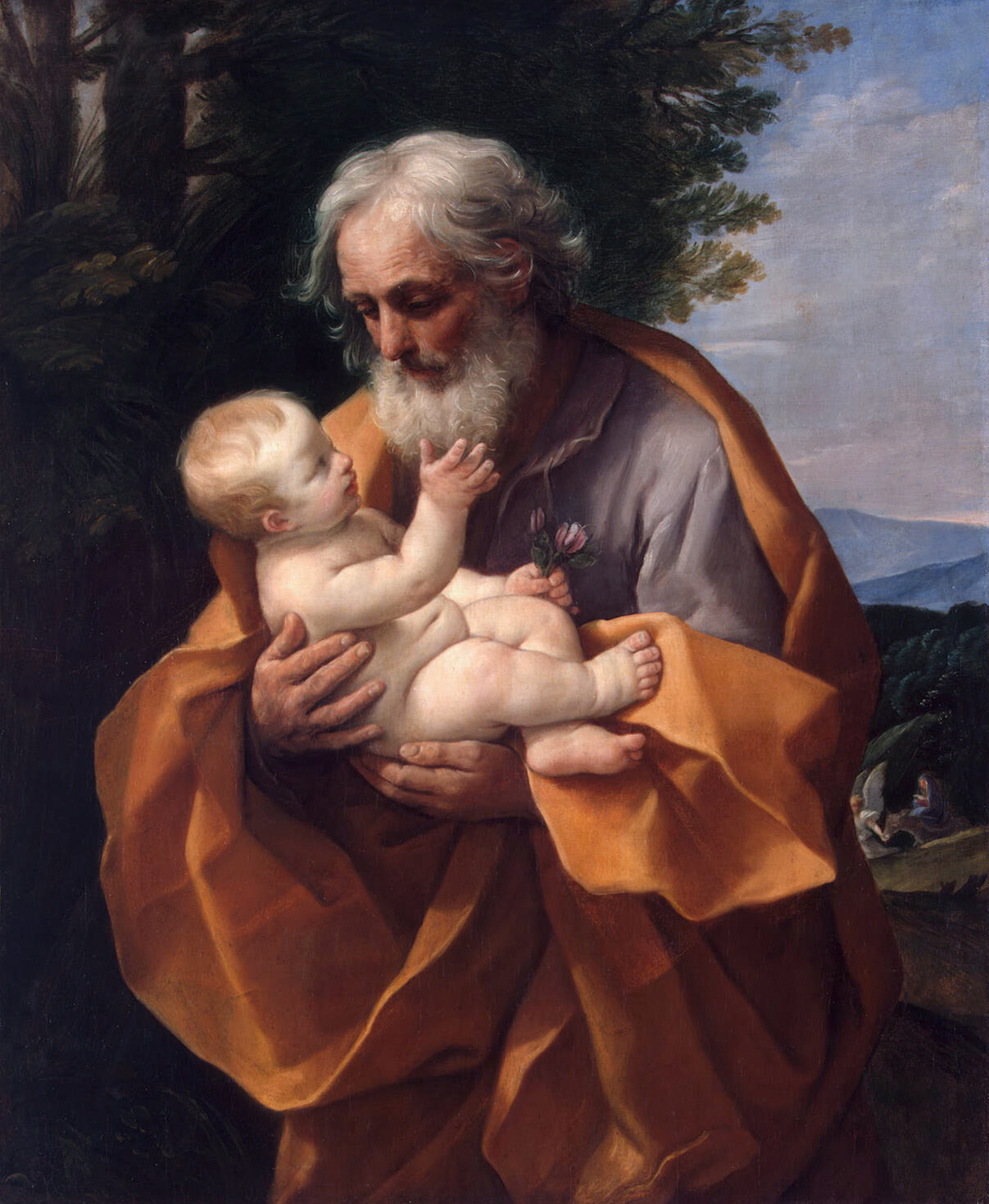
Saint Joseph, our Father and Lord: most chaste, most pure. You were found worthy to carry the Child Jesus in your arms, to wash him, to hug him. Teach us to get to know God, and to be pure, worthy of being other Christs. And help us to do and to teach, as Christ did. Help us to open up the divine paths of the earth, which are both hidden and bright; and help us to show them to mankind, telling our fellow men that their lives on earth can have an extraordinary and constant supernatural effectiveness. (The Forge, 553)

Love Saint Joseph a lot. Love him with all your soul, because he, together with Jesus, is the person who has most loved our Blessed Lady and been closest to God. He is the person who has most loved God, after our Mother. He deserves your affection, and it will do you good to get to know him, because he is the Master of the interior life, and has great power before the Lord and before the Mother of God. (The Forge, 554)

Tuesday, February 28, 2012

Meditation for the Second Sunday of Lent


Meditation on the Transfiguration
(Gospel for Second Sunday of Lent)

Troparion
You were Transfigured on the Mount,
O Christ God,
Revealing Your glory to Your disciples as far as they could bear it.
Let Your everlasting Light shine upon us sinners!
Through the prayers of the Theotokos,
O Giver of Light, glory to You!

Kontakion
On the Mountain You were
Transfigured, O Christ God,
And Your disciples beheld Your glory as far as they could see it;

So that when they would behold You crucified,
They would understand that Your
 suffering was voluntary,
And would proclaim to the world,
That You are truly the Radiance of the Father!

Troparion
Come, you faithful, let us welcome the Transfiguration of Christ,
And let us joyfully cry as we celebrate the prefeast:
"The day of holy gladness has come;
The Lord has ascended Mount Tabor
To radiate the beauty of His divinity."

-Taken from the Byzantine Liturgy for the Feast of the Transfiguration

Friday, February 24, 2012

Get Thee to the Confessional!


Get Thee to the Confessional!
by Mr. Phil Kosloski, Director of Adult Formation

Most people dread going to confession. Why do I have to confess my sins to a priest? Can't I go straight to God? Doesn't God already know my sins?

The short answer is that confession is for our sake and not God's. God knows everything about our lives. He knows every strand of hair on our head. Obviously He knows every sin we commit. However, like a loving father He wants us to approach Him for forgiveness.

As any parent knows, when your child does something wrong right in front of you, what do you tell them? "Say you're sorry!" Now do parents do this for their sake? No. They know what the child did wrong. However, all good parents want their children to know that what they did was wrong and that they need to apologize for it. Similarly, God knows our sins, but He wants us to make the effort, realize what we did was indeed wrong and then apologize for our wrongdoing.

Why can't I confess my sins straight to God? Sin by its very nature is communal. As much as we deny it, all of our sins hurt other people. Even our thoughts injure our communion with others for they lead to actions or words that damage. Consequently, we need to not only reconcile with God, but also with the Church. The priest is the representative of the Church and he reconciles the sinner, bringing them back into full communion with the People of God.

Also, we must always remember that it is not the priest who absolves our sins but God! God uses the priest as an instrument of grace for the penitent. The priest is acting in persona Christ, in the person of Christ. Jesus Christ is the one who is truly there in the sacrament and He alone grants pardon.
Sin is also naturally prideful. Every sin stems from a prideful attitude that "I" know better than God. Gossiping and slandering about friends and relatives makes the statement that "I" have the ability to enact judgment. "I" know what is good and what is evil. "I" have a special knowledge that no one else has. "I" have sex outside of marriage, because "I" think it is OK. As a result, confessing our sins demands a humiliation. We must approach the priest and admit our fault and say that "I detest all my sins." There is a reason why we don't want to go to confession to a priest: we don't want to be humiliated! We want to keep our sin to ourselves as a pet that no one knows about. Going to a priest "lets the cat out of the bag" and we can no longer keep our sin hidden. However, the first step to sanctity demands this humility. The only way we can get to Heaven is if we recognize this fact: God is God and we are not.

The Good News

Thankfully, there is good news. God is not out to smite us. Instead, He beckons us to the confessional and like a loving father, embraces us. Read the story of the Prodigal Son in Luke chapter 15. There you will see an image of God that is not a white man with a grey beard sitting on a cloud, looking down upon us and ready to strike poor sinners with a lightning bolt. That is not who God is! God is an "eternal exchange of love" and He has "destined us to share in that exchange" as the Catechism tells us. The reason why He wants us to go to confession is because He loves us!

Think of it this way: in any relationship, to truly love someone implies that you try your best not offend them. You do not do this because you are afraid that they are going to hurt you, you do this because you love them. You can think of nothing else than to avoid any occasion that might possibly offend them. To love them is to venerate their goodness and to do all in your power to love them rather than hurt them. This is what confession is all about! We must love God, not be afraid of Him!

When should I go to confession? The Church prescribes the following:
(CCC 1457) Anyone who is aware of having committed a mortal sin must not receive Holy Communion, even if he experiences deep contrition, without having first received sacramental absolution, unless he has a grave reason for receiving Communion and there is no possibility of going to confession. Children must go to the sacrament of Penance before receiving Holy Communion for the first time.

1458 Without being strictly necessary, confession of everyday faults (venial sins) is nevertheless strongly recommended by the Church. Indeed the regular confession of our venial sins helps us form our conscience, fight against evil tendencies, let ourselves be healed by Christ and progress in the life of the Spirit. By receiving more frequently through this sacrament the gift of the Father's mercy, we are spurred to be merciful as he is merciful. (emphasis added)
In summary, we go to confession when we have committed a mortal sin, for we can NOT go to Holy Communion when we commit a mortal sin! What is a mortal sin?

(CCC 1857) For a sin to be mortal, three conditions must together be met: "Mortal sin is sin whose object is grave matter and which is also committed with full knowledge and deliberate consent."1311858 Grave matter is specified by the Ten Commandments, corresponding to the answer of Jesus to the rich young man: "Do not kill, Do not commit adultery, Do not steal, Do not bear false witness, Do not defraud, Honor your father and your mother."132 The gravity of sins is more or less great: murder is graver than theft. One must also take into account who is wronged: violence against parents is in itself graver than violence against a stranger. (emphasis added)
The Church also instructs us that ALL SEXUAL SIN IS GRAVE MATTER. The Church instructs this way not because sex is bad, but because sex is so HOLY and GOOD that God destined it only to be expressed in the right way in the context of the Sacrament of Marriage. Also, contraceptives are intrinsically disordered and inhibits the sexual act to be an act of the renewing of wedding vows (I promise to accept children lovingly from God). Pornography is also a grave sin, for it debases the sexual act to a plaything and uses women as objects. The greatest oppression of women is pornography. It says that women are objects to use and throw away instead of human beings of beauty and infinite worth. (click here for more on contraceptives and pornography. For help breaking free from pornography, click here)

We also go to confession when we commit venial sin, because it "helps us form our conscience, fight against evil tendencies, let ourselves be healed by Christ and progress in the life of the Spirit."

Can't find the time to go to confession? There are many opportunities to go to confession in our parish and in the deanery. Coming up we will be having a Lenten Penance service which can be found in the bulletin. Still feel like there isn't enough opportunity to go to confession? Pray for priests! Not only do we need more in the vineyard, but priests do not always know the importance of confession. Pray that more priests will recognize the beauty of the Sacrament and offer it more. It also never hurts to send a priest an uplifting letter thanking them for being available for confession. Priests always get nasty letters. Why not give them a letter that encourages and lifts them up? Then they will see the beauty and possibly offer confession more.

Don't know how to go to confession? There are pamphlets in the back of Church as well as online. You can check out an Examination of Conscience at: 


Get Thee to the Confessional!


More resources on Confession:


Thursday, February 23, 2012

Reflections on Ash Wednesday

First, here is an excerpt on what the Pope had to say about Ash Wednesday


Ash Wednesday is a day of fasting and penance on which we begin a new journey towards the Easter of Resurrection, the journey of Lent. I would like to reflect on the liturgical sign of the ashes, a material sign, a natural element that, in the Liturgy, becomes a sacred symbol, so important on this day that marks the start of our Lenten journey. In ancient times, in the Jewish culture, it was common to sprinkle one’s head with ashes as a sign of penance, and to dress in sack-cloth and rags. For us Christians, there is this one moment which has important symbolic and spiritual relevance.
Ashes are the material sign that brings the cosmos into the Liturgy. The most important signs are those of the Sacraments: water, oil, bread and wine, which become true sacramental elements through which we communicate the Grace of Christ who comes among us. The ashes are not a sacramental sign, but they are linked with prayer and the sanctification of the Christian people. Before the ashes are placed on our heads, they are blessed according to two possible formulae: in the first they are called “austere symbols”, in the second, we invoke a blessing directly upon them, referring to the text in the Book of Genesis which can also accompany the imposition of the ashes: “Remember that you are dust and unto dust you shall return”. Read More...

Here is an excerpt of an additional reflection via the New Liturgical Movement by Dom Prosper Gueranger:

This was the motive the Church had in enriching her liturgy with the solemn rite, at which we are to assist this morning. When, upwards a thousand years ago, she decreed the anticipation of the lenten fast by the last four days of Quinquagesima week, she instituted this impressive ceremony of signing the forehead of her children with ashes, while saying to them those awful words, wherewith God sentenced us to death: 'Remember, O man, that thou art dust, and into dust thou shalt return!' But the making use of ashes as a symbol of humiliation and penance, is of a much earlier date than the institution to which we allude. We find frequent mention of it in the Old Testament. Job, though a Gentile, sprinkled his flesh with ashes, that, thus humbled, he might propitiate the divine mercy and this was two thousand years before the coming of our Savior. The royal prophet tells us of himself, that he mingled ashes with his bread, because of the divine anger and indignation. Many such examples are to be met with in the sacred Scriptures; but so obvious is the analogy between the sinner who thus signifies his grief, and the object whereby he signifies it, that we read such instances without surprise. When fallen man would humble himself before the divine justice, which has sentenced his body to return to dust, how could he more aptly express his contrite acceptance of the sentence, than by sprinkling himself, or his food, with ashes, which is the dust of wood consumed by fire? This earnest acknowledgment of his being himself but dust and ashes, is an act of humility, and humility ever gives him confidence in that God, who resists the proud and pardons the humble.

Wednesday, February 22, 2012

Fast and Pray


An excerpt from a reflection on Ash Wednesday by Fr. Steven Markantonis from the Theology of the Body Institute
"When asked why his disciples do not fast, the Lord Jesus responds, "Can the wedding guests mourn as long as the bridegroom is with them? The days will come, when the bridegroom is taken away from them and then they will fast." (Mt 9:15) The days will come, and are now finally here! Lent begins. Throughout the liturgical year we are afforded the benefit of experiencing the entire life of Christ our Bridegroom. Our Lenten journey is thus a sacramental entrance into the mystery of the Lord's suffering and death. We must enter into the sorrow, bitterness, pain and loss of the Lord's death; for there can be no Easter Sunday without Good Friday. As we journey into this reality, we too suffer as our beloved, our divine spouse, our everything and all, is being taken away from us. We find ourselves again abandoned and afraid.
 [...]
The fast is our preparation for the feast. It is an interior preparation, a circumcision of the heart, through which we take up our cross and walk daily with our Beloved. He endured what he did to heal us of our sins. No doubt then, when we fast we share his cross so as to be purified and healed of any lesser loves that get in the way of our one true Love. We literally become emptied so as to be filled with the new wine of divine grace. The Bridegroom is being taken away, but he will return. Then, we will share in the victory feast, the nuptial feast, when our Beloved has conquered all threats and divisions, and brought us to the newness of life!"

Thursday, February 16, 2012

Pope Exhorts Americans to Resist Secularism

On January 19,  Pope Benedict addressed bishops from the District of Columbia, Maryland, Delaware, Virginia, West Virginia, the U.S. Archdiocese for the Military Services, and the Virgin Islands. These U.S. bishops were in Rome for their periodic “ad limina” visits, which included meetings with the pope and Vatican officials, covering a wide range of pastoral matters.
His words provide some sober reflection for us. As is usually the case, I would like to provide excerpts of the Pope’s remarks from a CNS News Article and then present my own comments in red.
Pope Benedict XVI warned visiting U.S. bishops that “radical secularism” threatens the core values of American culture, and he called on the church in America, including politicians and other laypeople, to render “public moral witness” on crucial social issues.
This will call for greater courage and hard work than is evident in many clergy and laity in the Church today. Too often the instinct is to play it safe. And when we are outspoken it is only in the safety of like-minded family and friends. Public moral witness must begin with clergy but it cannot end there. Also public moral witness requires a deep commitment in terms of time and even money.
Increasingly for clergy, the pulpit cannot be a place for abstractions and generalities like “do good, avoid evil.” We have to speak clearly to the issues of our day and be willing to name them. Clear assessments like sin, mortal sin, hell, judgment, right, wrong, good, and evil, must once again find a place in our homilies. Further, we must name issues clearly, abortion, homosexual acts, fornication, contraception, neglect of the poor, greed, corruption and so forth. Ambiguity must give way to clarity. But clarity must also reflect charity. We are to speak the truth in love.
Parents too and every level of the laity must give clear moral witness to their children. Parents must be willing to raise and discipline their children and instruct them clearly in the faith and moral life. It is not enough to say what is taught, but good teaching must also address why. This takes courage and the sacrifice of time.
Catholics in general must be far more willing to enter the public square without apology or fear, and be willing to speak the truth in love. In so doing we must be willing to accept that we will be misquoted, misunderstood and ridiculed. We must accept that we will get it with both barrels and learn that, just because people are angry with us, does not mean we did anything wrong.
Read More...