St. Valentine
Feastday: February 14
Patron of Love, Young People, Happy Marriages
Died: 269
Valentine was a holy priest in Rome, who, with St. Marius and his family, assisted the martyrs in the persecution under Claudius II. He was apprehended, and sent by the emperor to the prefect of Rome, who, on finding all his promises to make him renounce his faith ineffectual, commanded him to be beaten with clubs, and afterwards, to be beheaded, which was executed on February 14, about the year 270. Pope Julius I is said to have built a church near Ponte Mole to his memory, which for a long time gave name to the gate now called Porta del Popolo, formerly, Porta Valetini. The greatest part of his relics are now in the church of St. Praxedes. His name is celebrated as that of an illustrious martyr in the sacramentary of St. Gregory, the Roman Missal of Thomasius, in the calendar of F. Fronto and that of Allatius, in Bede, Usuard, Ado, Notker and all other martyrologies on this day. To abolish the heathens lewd superstitious custom of boys drawing the names of girls, in honor of their goddess Februata Juno, on the fifteenth of this month, several zealous pastors substituted the names of saints in billets given on this day.The Origin of St. Valentine
The origin of St. Valentine, and how many St. Valentines there were, remains a mystery. One opinion is that he was a Roman martyred for refusing to give up his Christian faith. Other historians hold that St. Valentine was a temple priest jailed for defiance during the reign of Claudius. Whoever he was, Valentine really existed because archaeologists have unearthed a Roman catacomb and an ancient church dedicated to Saint Valentine. In 496 AD Pope Gelasius marked February 14th as a celebration in honor of his martyrdom.
Read More...

Showing posts with label Daily Reflections. Show all posts
Showing posts with label Daily Reflections. Show all posts
Tuesday, February 14, 2012
Saint Valentine's Day is also about a Saint


Wednesday, January 18, 2012
March for Life Coverage

Thursday, December 29, 2011
It is Still Christmas

Still Christmas: Advent & Christmas Family Traditions
by Steven D. Greydanus Tuesday, December 27, 2011
All Advent long, observant Catholics and other Christians hold the line against premature Christmas, holding off on decking the halls and singing Christmas carols during what is meant to be a time of preparation.
Now, as the world is busily dismantling what’s left of its Christmas trappings, it’s time for Christians to double down on the continued celebration of the Christmas season, which continues through the Christmas Octave (to January 1, the eighth day after Christmas, and thus the day of Jesus’ circumcision, celebrated as the feast of Mary the Mother of God) until after Advent to the feast of the Baptism of the Lord. (This year that means that Christmas runs through January 9, and ordinary time returns on January 10.)
This is especially important for families with young children, I think, to instill in them a proper sense of liturgical time at an early age. As far as the larger culture goes, the notion of the Christmas season would seem to be a lost battle. (Suz commented recently how depressing it was to get an “After Christmas Sale” catalog before Christmas actually arrived: “It’s like it’s never actually Christmas!”)
Within our families and churches, though, we can sustain a culture of resistance. How do we do this?
.......
What we do after Christmas is as important as what we do during Advent. It’s important to celebrate the Christmas season as more than a wind-down from the big day. Here are some things we do.
First, as tempting as it may be to take vacation time from work before Christmas, I save mine for the Christmas Octave—and if I can take the first week in January and complete the “12 Days,” so much the better. We’re fortunate enough to be friends with a number of large families at our parish, and every year our families get together for a Christmas party during the Christmas Octave—never before Christmas. We sing carols and so forth.
This is especially important for me with respect to my kids’ experience, because our family generally celebrates Christmas Day itself with family members who aren’t believers. I want my kids to have a larger experience of celebrating the Christmas season with other believers—not just in our family, and not just in Mass.
[Emphasis Added]
Read more: http://www.ncregister.com/blog/steven-greydanus/still-christmas-1#more#ixzz1hxL1DqYj
Tuesday, December 13, 2011
Importance of Catholic Traditions in the Home
 Christmas is by far the most widely celebrated Christian holiday in
the Western world. However, it is also the most widely secularized
Christian holiday. Many of the Catholic traditions that were done in the
past in the countries of our ancestors have all but gone here in
America. The Christmas tree tends to be the only remnant of what was a
distinct Christian culture that dwelt in the homes during this time of
year. This is unfortunate, for the principal way that our children know
and practice the faith is how it is taught in the home. If our children
come home to an entirely secular way of celebrating Christmas, it should
come as no surprise to see so many children that do not know what
Christmas is about. In the end, if they know more about Santa Claus then
Jesus Christ, it is hard for our children to celebrate Christmas for
what it truly is.
Christmas is by far the most widely celebrated Christian holiday in
the Western world. However, it is also the most widely secularized
Christian holiday. Many of the Catholic traditions that were done in the
past in the countries of our ancestors have all but gone here in
America. The Christmas tree tends to be the only remnant of what was a
distinct Christian culture that dwelt in the homes during this time of
year. This is unfortunate, for the principal way that our children know
and practice the faith is how it is taught in the home. If our children
come home to an entirely secular way of celebrating Christmas, it should
come as no surprise to see so many children that do not know what
Christmas is about. In the end, if they know more about Santa Claus then
Jesus Christ, it is hard for our children to celebrate Christmas for
what it truly is.The family was always meant to be a “domestic church,” where the father and mother passed down to their children what it meant to be a Christian. God revealed this to us all the way back in the time of Noah and Abraham. This still holds true today and has been reiterated by Blessed John Paul II and Pope Benedict XVI. Consequently, when celebrating Christmas, our children are supposed to learn from us what this feast means and how it impacts their lives.
Yet, we are not always good with talking to our children. In this modern age it is even more difficult with cell phones, iPods, etc. However, sometimes it isn’t always our words that affect our kids the most as our actions. In particular, it is very often the traditions of Christmas that speak to our children and ingrain in them a knowledge that words can not do.
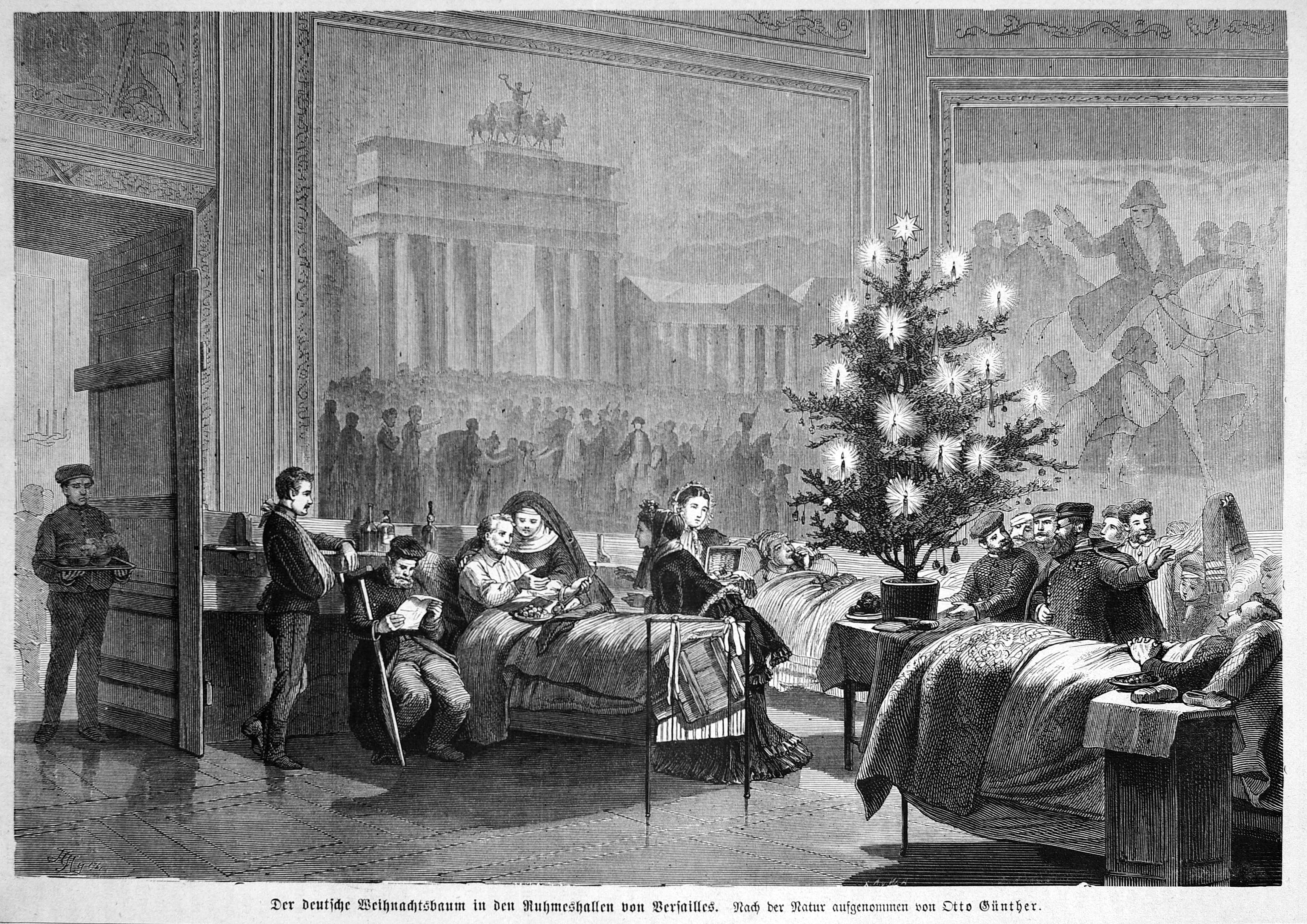
The most important clue to the origin of the Christmas tree as we know it comes from the mystery and miracle plays, and in particular from the Tree of Good and Evil in the earthly Paradise.
These plays were first performed in the late Middle Ages and their purpose was to teach religion. It should be remembered that people in general were illiterate. To spread and to keep the faith alive, to make known the Sacred Scriptures, preaching was essential.
It was thought that acting out Bible and Gospel episodes for the humbler classes would facilitate this task. As a rule, these religious plays were enacted for the celebration of an episode or of the saint whom they featured, and they became popular throughout Europe. A famous play was the performance put on for holy Christmas, celebrated on 25 December.
On Christmas Eve, 24 December, Adam and Eve would be commemorated with the highly popular episode of the Tree of the earthly Paradise; they would tower on the stage together with the devil, disguised as a serpent, Eve picking an apple and Adam eating it. Original sin, expiated by Jesus born on the 25th, was symbolized on the night of 24 December. The tree ought to have been an apple tree, but since an apple tree would have been inappropriate in winter, a fir tree was set on the stage and some apples put on its branches or, to symbolize the future coming of Redemption, wafers prepared with crushed biscuits in special moulds that were symbols of the Eucharistic presence of Jesus, as well as sweets and gifts for children.
Even when the religious tableaux were abandoned, the Tree of Paradise continued to be associated with Christmas in many people's minds.[Catholic Culture]Consequently, when putting up Christmas trees in the home became a tradition in Germany, they always refrained from putting it up until Christmas Eve. Also, since the tree wasn't put up until the 24th, the tree was not taken down until January 6th. This date is the day when the Magi came to visit the baby Jesus and is called the Epiphany. This more traditional usage of the Christmas tree spans the liturgical season of Christmas instead of Advent.

This is not to say you cannot have a tree up before Christmas Eve, but there is also a tradition called the “Jesse Tree” which is an Advent tradition to help us prepare for Christmas. This tree is put up at the very beginning of Advent and so would correspond with the American tradition of putting up the tree after Thanksgiving. Here is a little about the Jesse Tree:
Another tradition deals with a fast that was kept on Christmas Eve, and after going to Midnight Mass, there would be a grand feast to celebrate Christ’s birth. This tradition reflects the penitential attitude of Advent. It also displays perfectly the adage, "Fast before you Feast."The Jesse Tree dates back to the middle ages and came from Europe. Even some ancient cathedrals have Jesse Tree designs in their stained glass windows. The "tree" is usually a branch or sapling and is decorated with various symbols that remind us of the purpose and promises of God from Creation to the Birth of Jesus Christ.Jesse was the father of King David and God promised David that his Kingdom would last forever. Two centuries after the death of King David, God spoke through the prophet Isaiah and said:And there shall come forth a rod out of the stem of Jesse, and a branch shall grow out of his roots: and the spirit of the Lord shall rest upon him: the spirit of wisdom and understanding, the spirit of counsel and fortitude, the spirit of knowledge, and of the fear of the Lord. (Isaiah 11:1-2)Each Jesse Tree ornament usually consists of a handmade symbol or drawing that represents one of the major stories of the Old Testament along with a brief verse of Scripture from that story. [Catholic Culture]
A Polish tradition is the special observance of Christmas Eve and a special meal on that day:
For days in advance, Poles prepare the traditional foods and everyone anxiously awaits the moment when the first star, known as the Gwiazdka, appears in the eastern sky. For that is when the feast to commemorate the birth of the Christ Child begins.
There is always a thin layer of hay under the white tablecloth in memory of the Godchild in the manger. Before sitting down at the table, everyone breaks the traditional wafer, or Oplatek and exchanges good wishes for health, wealth and happiness in the New Year. This is such a deeply moving moment that often tears of love and joy are evoked from the family members who are breaking this symbolic bread. The Oplatek is a thin, unleavened wafer similar to the altar bread in the Roman Catholic Church. It is stamped with the figures of the Godchild, the blessed Mary, and the holy angels. The wafer is known as the bread of love and is often sent by mail to the absent members of the family.
A lighted candle in the windows symbolizes the hope that the Godchild, in the form of a stranger, may come to share the Wigilia and an extra place is set at the table for the unexpected guest. This belief stems from the ancient Polish adage, "A guest in the home is God in the home."German Christmas traditions have for the most part been transferred entirely to American culture. Click here to see a chart that compares the two celebrations of Christmas.
The Wigilia is a meatless meal, no doubt the result of a long-time Church mandate that a strict fast and abstinence be observed on this day before Christmas. Although the Church laws have been revised and permit meat to be eaten on this day, the traditional meal remains meatless. Items that would normally be included in a traditional Wigilia menu include mushroom soup, boiled potatoes (kartofle), pickled herring (sledzie), fried fish, pierogi, beans and sauerkraut (groch i kapusta), a dried fruit compote, babka, platek, assorted pastries, nuts and candies.
After the meal the members of the family sing Polish Christmas Carols called the koledy while the children wait impatiently around the Christmas tree or choinka for the gifts to be exchanged.
Christmas Day itself is spent in rest, prayer, and visits to various members of the family. In Poland, from Christmas Day until the twelfth night, boys trudge from village to village with an illuminated star and a ranting King Herod among them to sing carols. Sometimes, they penetrate the towns in expectation of more generous gifts.[Polish American Center]
One more tradition is the singing of “Happy Birthday” to Jesus on Christmas Day. This is a more recent tradition, but something that displays to children the reality of Christmas
These and other traditions put the emphasis on the day of Christ’s birth, which is the central mystery we celebrate at Christmas.
Saturday, November 26, 2011
Saint John the Baptist the Forerunner
"He must increase, but I must decrease." (John 3:30)

Byzantine mosaic (12th century) in Hagia Sophia in Istanbul
Friday, November 25, 2011
A meditation on "Black Friday"
From CatholicVote:
A simple title for a simple post … I would note only that Blessed John Paul’s critique of our culture applies to all of us. None of us, myself of course included, is immune.
...
“The more one possesses, the more one wants, while the deeper human hopes remain unsatisfied and even stifled.”
“The individual today is often suffocated between two poles represented by the State and the marketplace. At times it seems as though he exists only as a producer and consumer of goods, or as an object of State administration.”
“It is not wrong to want to live better; what is wrong is a style of life which is presumed to be better when it is directed towards ‘having’ rather than ‘being,’ and which wants to have more, not in order to be more but in order to spend life in enjoyment as an end in itself.”


“It is therefore necessary to create life-styles in which the quest for truth, beauty, goodness, and communion with others.”
Thursday, November 24, 2011
Thanksgiving

However, this national holiday is also becoming a symbol of the past and how families used to get together. Nowadays, the majority of families are split up and the Thanksgiving table is getting smaller and smaller. Fears of offending other family members with choices of lifestyles are beginning to sow division in the celebration of Thanksgiving. Instead of being a time of sharing what you are truly thankful for, families are rushing through the meal without talking to one another and watching the football game on the TV in kitchen.
What is to be done then in this culture that is so hostile to the family? Simply put, a greater realization that everything thing we have is a gift.
So often in our everyday lives we believe that what we receive is our due. Our job, our family, our money, tend to be viewed as ours and not God's. Even our very life is viewed as something we posses. In the end, though, nothing is ours. Everything is a gift.
Saint Francis of Assisi displayed this perfectly when he preached to hundreds of birds in a nearby tree,
"My little sisters the birds, ye owe much to God, your Creator, and ye ought to sing his praise at all times and in all places, because he has given you liberty to fly about into all places; and though ye neither spin nor sew, he has given you a twofold and a threefold clothing for yourselves and for your offspring. Two of all your species he sent into the Ark with Noe that you might not be lost to the world; besides which, he feeds you, though ye neither sow nor reap. He has given you fountains and rivers to quench your thirst, mountains and valleys in which to take refuge, and trees in which to build your nests; so that your Creator loves you much, having thus favoured you with such bounties. Beware, my little sisters, of the sin of ingratitude, and study always to give praise to God." From "The Little Flowers of St. Francis of Assisi," 1476This should be a great lesson for us. If the birds of the air have much to be thankful for, why should we not be thankful for all that God has given us?
Try as we may, we can never accomplish anything without God's help. This Thanksgiving, let us reinstate that blessed tradition of reciting to all our family members what we are thankful for. That way, we will recognize that it is not us who created the world, but God who is the author of life. Only then can our families be reunited and our culture begin to recognize the beauty of the family.
Wednesday, November 23, 2011
November 23rd - Blessed Miguel Agustin Pro

Miguelito, as his doting family called him, was, from an early age, intensely spiritual and equally intense in hi mischievousness, frequently exasperating his family with his humor and practical jokes. As a child, he had a daring precociouness that sometimes went too far, tossing him into near-death accidents and illnesses. On regaining consciousness after one of these episodes, young Miguel opened his eyes and blurted out to his frantic parents, "I want some cocol" (a colloquial term for his favorite sweet bread). "Cocol" became his nickname, which he would later adopt as a code name during this clandestine ministry.
[...]
In 1915, Miguel was sent to a seminary in Spain, where he remained until 1924, when he went to Belgium for his ordination to the priesthood in 1925. Miguel suffered from a severe stomach problem and after three operations, when his health did not improve, his superiors, in 1926, allowed him to return to Mexico in spite of the grave religious persecution in that country.
The churches were closed and priests went into hiding. Miguel spent the rest of his life in a secret ministry to the sturdy Mexican Catholics. In addition to fulfilling their spiritual needs, he also carried out the works of mercy by assisting the poor in Mexico City with their temporal needs. He adopted many interesting disguises in carrying out his secret mininstry. He would come in the middle of the night dressed as a beggar to baptize infants, bless marriages and celebrate Mass. He would appear in jail dressed as a police officer to bring Holy Viaticum to condemned Catholics. When going to fashionable neighboorhoods to procure for the poor, he would show up at the doorstep dressed as a fashionable businessmam with a fresh flower on his lapel. His many exploits could rival those of the most daring spies.
In all that he did, however, Fr. Pro remained obedient to his superiors and was filled with the joy of serving Christ, his King. Falsely accused in the bombing attempt on a former Mexican president, Miguel became a wanted man.
Betrayed to the police, he was sentenced to death without the benefit of any legal process. On the day of his execution, Fr. Pro forgave his executtioners, prayed, bravely refused the blindfold and died proclaiming, "Viva Cristo Rey", "Long live Christ the King!"[Source: Catholic Online]
[Photo: Source]
Tuesday, November 22, 2011
Memorial of Saint Cecilia - November 22nd

[Photo is by Sébastien Bertrand]
Monday, November 21, 2011
November 21st - The Entrance of the Most Holy Mother of God Into the Temple
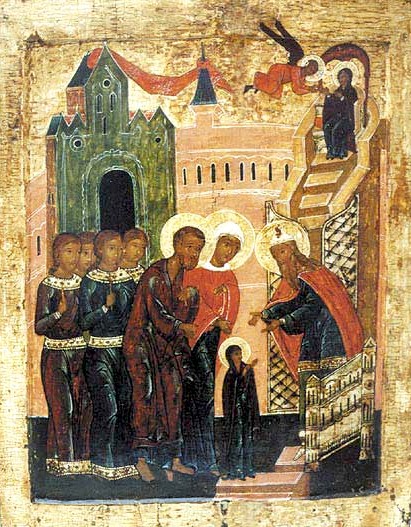
Presentation of Mary
"Sacred Scripture contains no text concerning the event commemorated in today's liturgy. For something of a historical background one may consult the apocryphal works, particularly the Protoevangel of St. James (ch. 4:1ff). After an angel had revealed her pregnancy, Anna is said to have vowed her future child Mary to the Lord. Soon after birth the infant was brought to the sacred precincts at which only the best of Israel's daughters were admitted. At the age of three she was transferred to the temple proper (7:2). According to legend, here she was reared like a dove and received her nourishment from the hand of an angel (8:1). [Catholic Culture]
Saturday, November 19, 2011
Solmenity of Jesus Christ the King
The Feast of Christ the King was established by Pope Pius XI in 1925 as an antidote to secularism, a way of life which leaves God out of man's thinking and living and organizes his life as if God did not exist. The feast is intended to proclaim in a striking and effective manner Christ's royalty over individuals, families, society, governments, and nations.
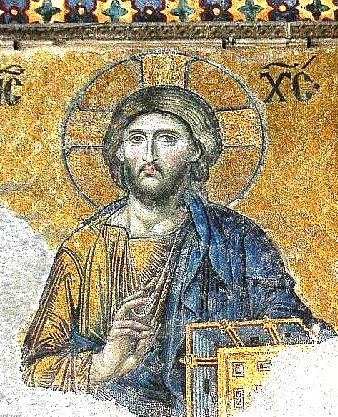
Today's Mass establishes the titles for Christ's royalty over men: 1) Christ is God, the Creator of the universe and hence wields a supreme power over all things; "All things were created by Him"; 2) Christ is our Redeemer, He purchased us by His precious Blood, and made us His property and possession; 3) Christ is Head of the Church, "holding in all things the primacy"; 4) God bestowed upon Christ the nations of the world as His special possession and dominion. (Catholic Culture)
Venerable Brethren, Greeting and the Apostolic Benediction.
In the first Encyclical Letter which We addressed at the beginning of Our Pontificate to the Bishops of the universal Church, We referred to the chief causes of the difficulties under which mankind was laboring. And We remember saying that these manifold evils in the world were due to the fact that the majority of men had thrust Jesus Christ and his holy law out of their lives; that these had no place either in private affairs or in politics: and we said further, that as long as individuals and states refused to submit to the rule of our Savior, there would be no really hopeful prospect of a lasting peace among nations. Men must look for the peace of Christ in the Kingdom of Christ; and that We promised to do as far as lay in Our power. In the Kingdom of Christ, that is, it seemed to Us that peace could not be more effectually restored nor fixed upon a firmer basis than through the restoration of the Empire of Our Lord. We were led in the meantime to indulge the hope of a brighter future at the sight of a more widespread and keener interest evinced in Christ and his Church, the one Source of Salvation, a sign that men who had formerly spurned the rule of our Redeemer and had exiled themselves from his kingdom were preparing, and even hastening, to return to the duty of obedience.- Pius XI, Quas Primas (emphasis added)
Friday, November 18, 2011
Friday of the Thirty-Third Week in Ordinary Time
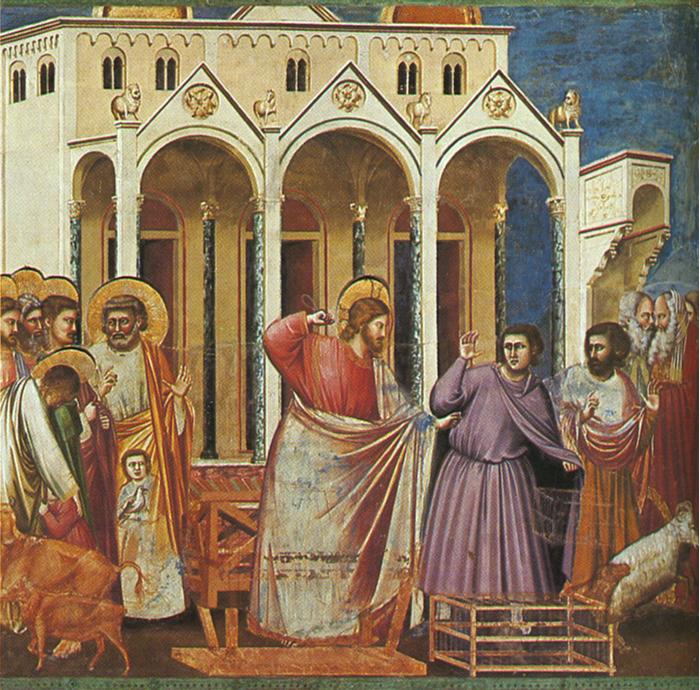
"Jesus entered the temple area and proceeded to drive out those who were selling things, saying to them, "It is written, My house shall be a house of prayer, but you have made it a den of thieves" (Luke 19: 45-46).
Today's Epistle and Gospel go perfectly together. We have on one hand Judas Maccabees cleansing the Temple in Jerusalem after overthrowing the Greeks and Jesus cleansing the Temple in Jerusalem after seeing the misuse of the Temple by the Jews. In both cases we see prayer in the Temple taking second place to Gentile worship. In the first case it is the worship of Greek gods and in the second place it is the worship of commerce. Both are condemned and thus cleansed.
For us it is very clear: we need to do some "temple" cleansing as well. Our own bodies are "temples of the Holy Spirit," and therefore need to be cleansed of anything unworthy of God. Simply put, we need to have our priorities straight. God needs to be at the center of our "temple" and anything that goes in or goes out of our "temple," needs to have God as its ultimate end. When Jesus says to "pray without ceasing," he doesn't necessarily mean to be in a church 24/7, but He does mean to do everything in life for the greater glory of God.
In the end, we must decrease and God must increase. Everything should be done for Him and with knowledge that our very lives should be an acceptable sacrifice to the Lord.
Thursday, November 17, 2011
Thursday of the Thirty-Third Week in Ordinary Time
"You did not recognize the time of your visitation" (Luke 19:44).
In today's Gospel, Jesus weeps over the city of Jerusalem as he prophecies the destruction of Jerusalem in 70 AD. Again and again the Jewish people throughout salvation history have not realized the time of their visitation. Too often they disobeyed God's commands and as a result they were taken away from their homeland in order to be taught a lesson in trust by their merciful Father.
Let us always be vigilant and live every day as it were our last. Then and only then will we be prepared to receive Christ when he comes to visit us.
In today's Gospel, Jesus weeps over the city of Jerusalem as he prophecies the destruction of Jerusalem in 70 AD. Again and again the Jewish people throughout salvation history have not realized the time of their visitation. Too often they disobeyed God's commands and as a result they were taken away from their homeland in order to be taught a lesson in trust by their merciful Father.
Let us always be vigilant and live every day as it were our last. Then and only then will we be prepared to receive Christ when he comes to visit us.
Wednesday, November 16, 2011
Wednesday of the Thirty-Third Week in Ordinary Time
 "Do not be afraid of this executioner, but be worthy of your brothers and accept death, so that in the time of mercy I may receive you again with them" (2 Maccabees 7:29).
The readings for today continue the second Book of Maccabees and continues the theme of martyrdom. Except in this case, we see the model for all parents in the mother of seven sons. They are brought all before the executioner, because of their faithfulness to God's covenant and each of them are killed. After the first six brothers are killed, they try to convince the youngest brother to renounce the faith. He doesn't renounce his faith, mainly due to the influence of his mother.
She tells him to, "not be afraid...but be worthy of your brothers and accept death." This mother knows what is truly important: God's law. As a good parent, we should never waver in our instruction of our children. Even if we are all brought together to suffer for the faith, we should always encourage our children to die rather than disobey God. This is so important, especially in today's society where we are too often attached to our children and want to please them above all things.
Next, the mother reveals why she is so hopeful for her son, "so that in the time of mercy I may recieve you again with them." She, a Jew, knows about the resurrection of the dead. She realizes that if a just person dies following God's commands, that person does not perish forever. Therefore, this mother holds onto the hope of the resurrection and knows that she will be reunited to her sons if they are all faithful. If her son rejects the faith now, she will lose her son forever. Death is not what will take her son from her, but sin will.
Let us then be good parents and encourage our children, even in the face of persecution to run the race and choose God over sin. For if they choose sin, we shall loose them forever.
Subscribe to:
Posts (Atom)